Smart Automatic-Opening Trash Bin
Smart automatic-opening trash binHow can we limit contact with frequently touched surfaces while improving the everyday user experience?It is around this challenge that I designed a smart automatic-opening trash bi...
Smart automatic-opening trash bin
How can we limit contact with frequently touched surfaces while improving the everyday user experience?
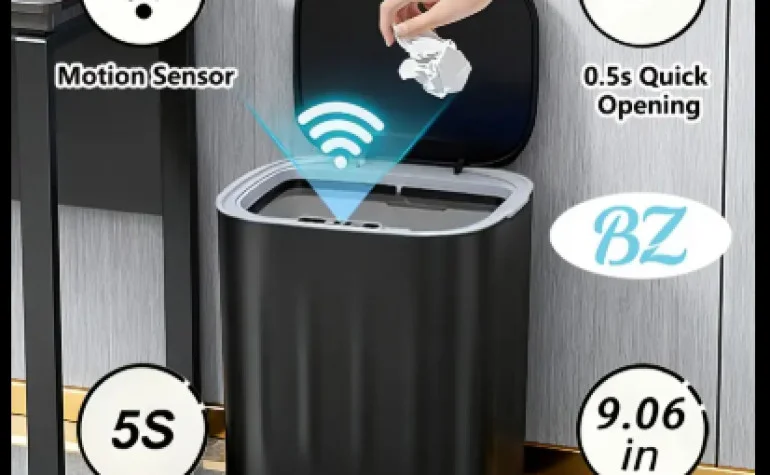
It is around this challenge that I designed a smart automatic-opening trash bin, a solution based on Internet of Things (IoT) technologies that opens the lid without physical contact, while also offering remote control and supervision.
In many places such as homes, offices, healthcare facilities or public spaces, trash bins are handled dozens of times a day. Repeated contact with their lid promotes the spread of germs and reduces comfort of use.
The goal of this project is therefore to make this equipment more hygienic, smart and connected.
How the system works
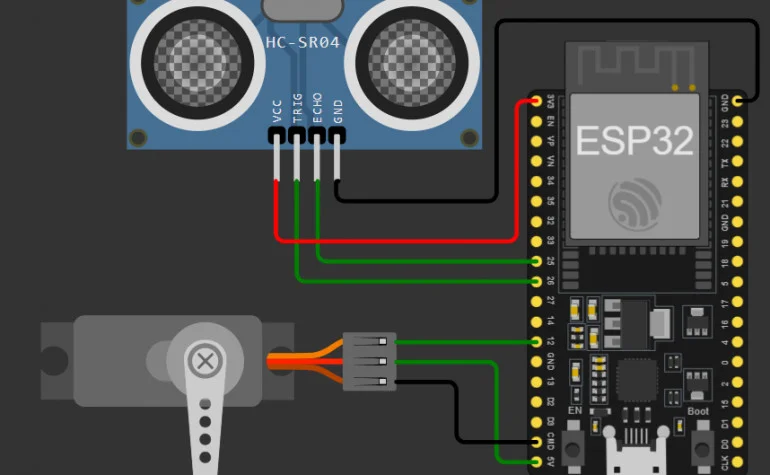
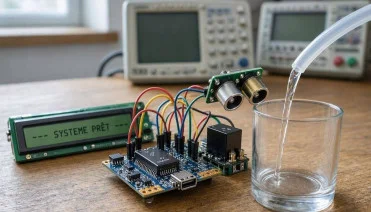
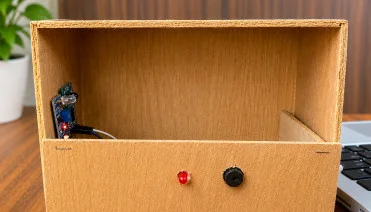
The system is based on an HC-SR04 ultrasonic sensor, responsible for detecting the presence of a person in front of the bin.
When a user brings their hand or a piece of waste within a predefined distance, the sensor measures this proximity and passes the information to an ESP8266.
The microcontroller analyzes the measurement and decides to activate an SG90 servo motor, which automatically opens the lid.
After a few seconds, a programmed delay allows the lid to close automatically, without any user intervention.
In parallel, the ESP8266 is connected to the YoupiLab IoT platform over the Wi-Fi network. This connection makes it possible to transmit opening events in real time and to offer a remote manual control from a web interface.
Thus, the bin no longer simply reacts to a user's presence: it becomes a connected object capable of communicating with a supervision platform.
Technologies used
ESP8266
The ESP8266 is the brain of the system.
It performs several essential functions:
- acquiring data from the ultrasonic sensor;
- processing the detection logic;
- controlling the servo motor;
- connecting to the Wi-Fi network;
- communicating with the YoupiLab IoT platform;
- transmitting opening events.
Thanks to its built-in Wi-Fi connectivity, it turns a simple automated system into a true connected object.
HC-SR04 ultrasonic sensor
The HC-SR04 is used to detect the presence of a user without any physical contact.
It works by emitting ultrasonic waves and then measuring the time needed for them to return after reflecting off an obstacle.
This technology makes it possible to accurately measure the distance between the bin and the user, ensuring automatic opening only when necessary.
SG90 servo motor
The servo motor is responsible for mechanically operating the lid.
Unlike a conventional motor, it allows precise control of the rotation angle, ensuring smooth opening as well as automatic closing after a set duration.
Its use improves the reliability of the mechanism while limiting energy consumption.
Wi-Fi communication
The Wi-Fi connection allows the system to communicate with the Internet.
Thanks to this connectivity, the bin can be supervised and controlled remotely without any physical intervention on the device.
HTTP protocol
The HTTP protocol is used for exchanges between the ESP8266 and the YoupiLab IoT platform.
Each command or opening event is transmitted via HTTP requests, allowing near-instant updates of the information.
System features
- Automatic, contactless lid opening.
- Presence detection using ultrasound.
- Automatic closing after a programmed delay.
- Remote manual control via the YoupiLab IoT platform.
- Real-time transmission of opening events.
- Wireless communication via Wi-Fi.
Application areas
This solution can be deployed in many environments:
- homes and smart houses;
- offices and coworking spaces;
- healthcare facilities;
- schools and universities;
- hotels and restaurants;
- shopping centers;
- airports, train stations and other public spaces.
Beyond automation, this project illustrates how the Internet of Things can improve the hygiene, comfort and efficiency of everyday equipment through smart integration between sensors, actuators and connected platforms.


No comments yet. Be the first!